


Sweetie Legends
Qingyue Games
Sweetie Legends is the kind of puzzle game I reach for when I want something gentle, colorful, and easy to understand without committing to a long session. It combines match-three play with a cast of cats and dogs, giving the familiar tile-swapping format a softer personality than many competitive or heavily dramatic puzzle games. After spending time with it, I found the main appeal is its relaxed rhythm: you can solve a board, put the phone down, and return later without feeling that the game demands your full attention.
That does not mean it is completely friction-free. Match-three games live or die by how they handle difficulty, progress, and spending, so the important question is not simply whether the boards are pleasant. It is whether the experience remains enjoyable when a level becomes stubborn, whether optional purchases feel reasonable, and whether the game suits the way you personally like to play. My impression is positive overall, but I would recommend approaching it as a casual puzzle companion rather than as a deep strategy game.
What the cat-and-dog puzzle format feels like in practice
The basic idea is immediately familiar: arrange matching pieces to clear them and work toward the objective of each board. That accessibility is one of the strongest reasons to try it. I did not need a long explanation before understanding the interaction, and the animal theme makes the presentation feel friendlier than a purely abstract grid. For adults who want a calm break, the combination is easy to settle into.
What makes this particular game more appealing than a bare match-three clone is the atmosphere around the puzzles. The cats and dogs give the adventure a recognizable identity, while the soft presentation supports short, low-pressure play. I would not choose it for intense competition or complicated planning, but I would choose it while waiting for an appointment, winding down before bed, or taking a few minutes away from work.
A realistic everyday use case is a commute or lunch break where I have only enough time for a handful of moves. The format works well there because the rules are simple to resume after an interruption. I can look at the board, identify a useful match, and continue without reconstructing a complicated story or remembering a large set of controls. That makes it more practical than puzzle games that require a long uninterrupted session.
Related News






There is also a useful distinction between relaxing and effortless. A match-three board can still require attention, especially when the objective is not completed by making obvious matches. I found that the best results came from pausing briefly before moving rather than tapping the first available combination. Even in a casual game, looking for a move that creates a larger chain or opens more of the board can make the difference between steady progress and a frustrating restart.
Small decisions matter more than fast tapping
My first practical tip is to avoid treating every possible match as equally valuable. When several moves are available, I look for the one that changes the most of the board or creates space near the area that matters for the objective. This is especially useful when the board contains awkward corners or separated sections. It turns the game from simple reflex play into light planning without making it feel like a demanding logic title.
A second useful habit is to scan the lower part of the board before moving pieces near the top. Matches created below can shift a larger portion of the layout and sometimes produce helpful follow-up combinations automatically. I would not rely on luck, but I also would not ignore the possibility that one carefully chosen move can improve several parts of the board at once.
Gallery
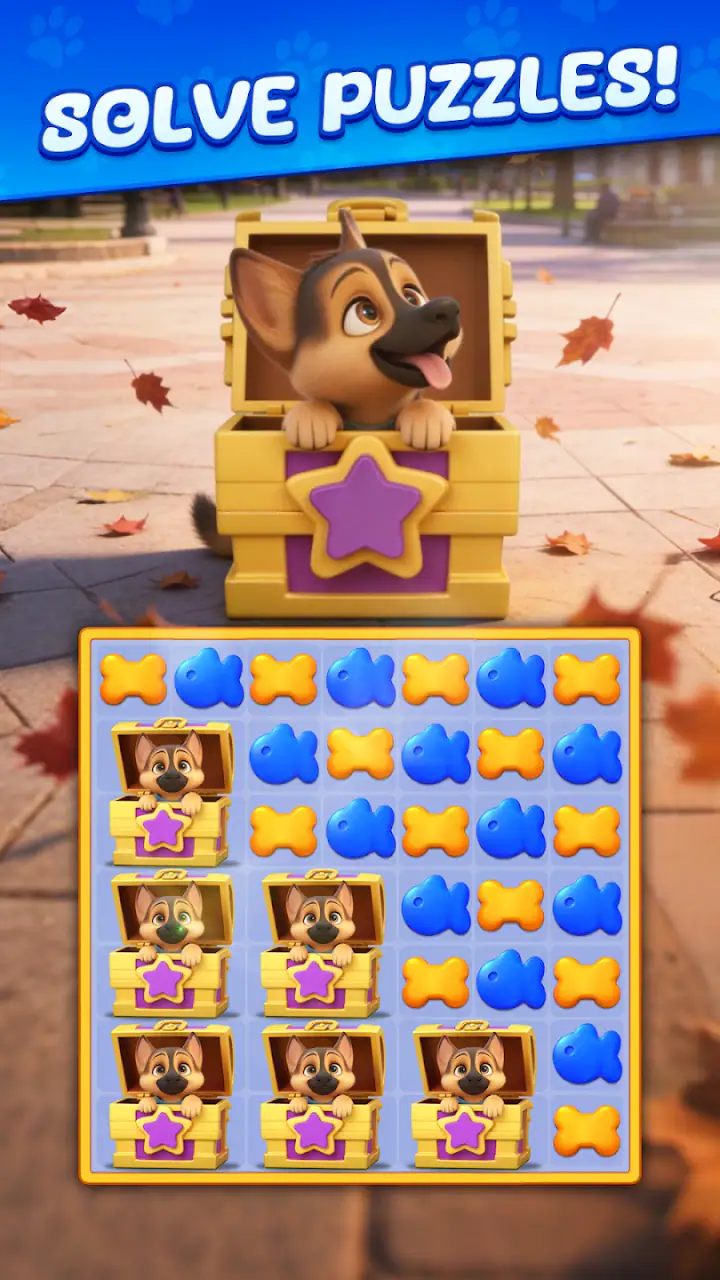
The animal theme may attract players who normally avoid puzzle games that look too serious. It also makes the game a reasonable choice for families looking for an Everyone-rated title, although the rating alone does not tell me whether every individual player will enjoy the progression. Younger players may appreciate the visual style, while adults are more likely to value the quiet, repeatable structure and the ability to play in short bursts.
Where it differs from the usual alternatives
Compared with a traditional match-three game built around a large story campaign, Sweetie Legends feels easier to approach as a casual diversion. The cats-and-dogs setting gives it more character than a board made only of colored shapes, but it does not change the core appeal: the satisfaction comes from recognizing patterns and clearing a puzzle efficiently.
Compared with a minimalist puzzle app, it offers a more playful presentation and a stronger sense of themed adventure. The trade-off is that anyone seeking pure, distraction-free logic may prefer a game with no character layer at all. In that case, the familiar animal framing might feel decorative rather than meaningful.
It is also different from competitive puzzle games that emphasize rankings, timed pressure, or direct clashes with other players. I would pick this one when I want control over my own pace. If your main motivation is proving that you are faster or better than other people, a competitive alternative will probably provide a clearer reason to keep playing.
Progress, difficulty, and the question of spending
Sweetie Legends is free to play, which makes trying it straightforward. The current version is 2.32.0, and the game runs on Android 6.0 or later. Those details matter for anyone using an older phone or tablet: checking the operating system before installing can save time, especially on a device that has not received recent updates.
The purchase range runs from $0.99 to $99.99 per item. I consider that a meaningful part of the decision, even though the game itself costs nothing to start. A low-cost optional purchase can be easy to justify for a regular player, while the upper end is substantial enough that I would want to be deliberate rather than buying impulsively after a difficult board.
I am careful here because the purchase range alone does not prove that the game is unfair. It does, however, mean that players should decide in advance whether they are comfortable spending and, if necessary, use the device’s purchase controls to avoid accidental transactions. My own approach would be to play without paying first, learn how the progression feels, and only consider a purchase if it solves a genuine annoyance rather than an emotional reaction to losing.
The pressure point in this genre usually appears when progress slows. A level that takes several attempts can make a player wonder whether patience is enough or whether spending is being encouraged. I would judge that on my own play pattern rather than assuming the worst. If I am still enjoying the search for a better move, replaying is part of the puzzle. If I am repeatedly playing only because I feel pushed toward a purchase, the experience has stopped being relaxing for me.
How I would manage a difficult stretch
When a board resists several attempts, I would first change my method instead of immediately looking for a paid shortcut. I would study the opening layout, identify which area is most restrictive, and prioritize moves that create room there. I would also avoid spending a useful combination simply because it is available if a later move could produce a larger clearance.
This approach is not a guarantee of success, because match-three boards can include elements of chance. That uncertainty is part of the genre’s charm for some players and its main weakness for others. If you need every result to follow from pure skill, a deterministic puzzle game may be a better fit. Sweetie Legends works best when you accept a mixture of observation, timing, and favorable board movement.
I would also set a simple personal rule: do not buy anything while annoyed. Waiting a few minutes gives me a clearer answer about whether I actually want the item or merely want the failed attempt to disappear. This is a small habit, but it is especially relevant when a free game offers purchases ranging from a single dollar to a much larger amount. The game can remain a pleasant hobby only if spending stays intentional.
Is the experience competitive or mainly personal?
For me, the strength of this game is personal progress rather than competition. I can focus on improving my choices, completing the current puzzle, and enjoying the animal theme without needing to compare my result with anyone else. That makes it more comfortable for players who dislike leaderboards or head-to-head pressure.
The trade-off is that players who need a strong long-term competitive goal may find the motivation limited. A match-three adventure can be satisfying because of its steady sequence of boards, but that satisfaction is different from mastering a fixed puzzle set or climbing a ranked ladder. I would recommend it to someone who wants a pleasant routine, not to someone searching for a serious esports-style challenge.
Fairness, in my view, also depends on how the player defines success. If success means relaxing for ten minutes and making a few thoughtful moves, the game has a good chance of feeling fair. If success means clearing every obstacle immediately without replaying or spending, expectations may be less comfortable. The free entry point is a genuine advantage, but it does not remove the need to decide how much patience and money you want to bring to the experience.
What I would want to understand before committing
One question many players will have is whether they can enjoy the game without purchases. My answer is that it is sensible to begin that way. The core game is free, so there is no reason to spend before you know whether the puzzle rhythm, animal presentation, and progression suit you. Treat the first sessions as a test of enjoyment, not as a promise to become a paying player.
Another question is whether the game is suitable for children. Its content rating is Everyone, and the friendly cats-and-dogs theme is approachable. Still, I would explain to younger players that free installation does not mean every optional item is free. On a shared device, purchase protections and clear family rules are more useful than relying on the cheerful presentation to communicate spending boundaries.
Players may also wonder whether it is a good replacement for a more serious puzzle title. I would say no, unless your definition of serious is simply “a game that makes me think a little.” Its appeal is the balance between approachable match-three decisions and a relaxing adventure mood. For complex deduction, wordplay, or carefully designed one-solution puzzles, another category would serve you better.
Finally, the developer is Qingyue Games, and the game has built a visible audience, with an average rating of 4.8 from around 17 thousand ratings. That is encouraging when deciding whether to try it, but I would still treat public enthusiasm as a starting signal rather than a guarantee that its pacing will match my preferences. Puzzle games are highly personal: one player’s soothing repetition is another player’s lack of depth.
Who should play, and who should skip it
I would recommend Sweetie Legends to adults who want a colorful, low-commitment match-three game with a softer animal theme. It is particularly suitable for players who enjoy short sessions, prefer personal progress to direct competition, and like puzzles that reward a little planning without requiring a notebook or a long tutorial.
I would also suggest it to someone who has grown tired of stark jewel-and-gem presentations but still enjoys the basic satisfaction of matching pieces. The cats and dogs provide a warmer identity, and that can make repeated puzzle sessions feel less anonymous.
I would skip it if I wanted a completely purchase-free experience with no temptation to spend. The available items reach a high upper price, so players who are uncomfortable with in-app purchasing should either use strong device controls or choose a paid-up-front puzzle instead. I would also skip it if I needed deep strategy, guaranteed deterministic outcomes, or a serious competitive structure.
My final view is that Sweetie Legends is best enjoyed as a patient, free-to-start puzzle break, not as a game to rush through. The match-three foundation is familiar, but the cats-and-dogs setting gives it enough personality to stand apart from a generic board. Its 100K-plus installs and strong average rating suggest that the format has found an audience, while the Everyone rating keeps the presentation broadly approachable.
I like that I can open it for a short session and make progress without learning a complicated system. I also appreciate that the main decision remains simple: look carefully, choose a useful match, and accept that some boards may need another attempt. The main caution is spending. Because optional items range from $0.99 to $99.99, I would keep purchases intentional and never use them as an automatic response to frustration.
For me, that balance leads to a favorable but measured recommendation. Try it if you want a friendly match-three adventure and are happy to let progress happen at a relaxed pace. Give it a pass if you need a purely skill-based puzzle, a competitive ladder, or a firmly purchase-free environment. For the right player, Sweetie Legends is a pleasant companion for small pockets of time, with enough charm to make familiar puzzle mechanics feel welcoming rather than routine.
FAQs for Sweetie Legends
What is Sweetie Legends, and how does the gameplay work?
Sweetie Legends is a casual puzzle adventure game built around colorful sweets, level-based challenges, and character progression. In each stage, you generally match or combine similar pieces to complete objectives within a limited number of moves or a time limit. As you advance, new obstacles, boosters, and special combinations appear, making later levels more strategic than the opening stages.
Is Sweetie Legends free to download and play?
Sweetie Legends can typically be downloaded and played without an upfront purchase, allowing you to try the core levels before spending anything. However, the game may include optional in-app purchases for extra lives, boosters, coins, or other helpful items. Advertising may also be part of the free experience, so players should review the store listing and device payment settings before downloading.
Does Sweetie Legends require an internet connection?
The basic puzzle experience may work during short periods without an internet connection, which is useful when traveling or playing in areas with limited coverage. Nevertheless, an online connection can be required for advertisements, cloud synchronization, events, updates, rewards, or purchases. Availability of offline features may vary by version, device, and operating system, so it is best to test the game after installation.
Are there ads or in-app purchases in Sweetie Legends?
Sweetie Legends may use advertisements and optional in-app purchases as part of its free-to-play model. Ads can sometimes provide rewards, such as additional moves or bonuses, while purchases may speed up progress or provide extra resources. You can usually play without buying anything, although some difficult stages may encourage spending. Parents should enable purchase restrictions if children use the device.
Is Sweetie Legends suitable for children, and what should parents know?
Sweetie Legends uses bright visuals, simple controls, and approachable puzzle mechanics that can make it suitable for casual players and families. The main concerns are advertising, optional purchases, and possible online connectivity rather than complex gameplay. Age ratings can differ between Android and iOS, so parents should check the current store classification, privacy information, and parental-control options before allowing a child to play.
Pros
- Bright
- charming visuals make the game appealing to casual players.
- Short levels fit well into quick gaming sessions.
- Simple controls are easy for newcomers to understand.
- Frequent rewards help maintain a steady sense of progress.
- Works well for players who enjoy relaxed match-style gameplay.
Cons
- Difficulty can increase sharply after the early levels.
- Some objectives may feel repetitive over longer sessions.
- Limited lives can interrupt play when several attempts are needed.
- Progress may feel slower without optional in-app purchases.
- The game may require a stable connection for certain features.


